Media tracking and monitoring of brand presence (clipping) have undergone a radical transformation thanks to natural language processing and intelligent automation. Traditionally, gathering appearances in print press, digital portals and social media required hours of manual work searching, classifying and building visibility reports. Today, access to advanced technology solutions lets communication and public relations teams optimize the capture of editorial appearances without compromising operating budgets.
In this context, using AI tools for clipping does not replace the communicator’s strategic evaluation, but automates detection of news impacts, allowing more time for brand sentiment analysis, reputational assessment and executive decision-making.
The danger of manual monitoring in corporate reputation
The most common mistake in public relations and institutional image management is to depend on manual, improvised reviews to evaluate a company’s media coverage. The dispersion of digital media, the speed of the news cycle and the growth of the news ecosystem make it impossible to detect all relevant mentions without technological assistance.
When an organization loses visibility over the news published about its business activity, executives or sector, it increases its vulnerability to reputational crises. A negative mention or informational inaccuracy not detected in time on a regional or specialized portal can escalate rapidly on digital platforms before the company manages to structure an official position.
Adopting free or freemium solutions powered by algorithms makes it possible to structure a continuous workflow, guaranteeing timely capture of mentions and making it easier to assess return on investment in public relations.
Four open solutions for optimizing media tracking with artificial intelligence
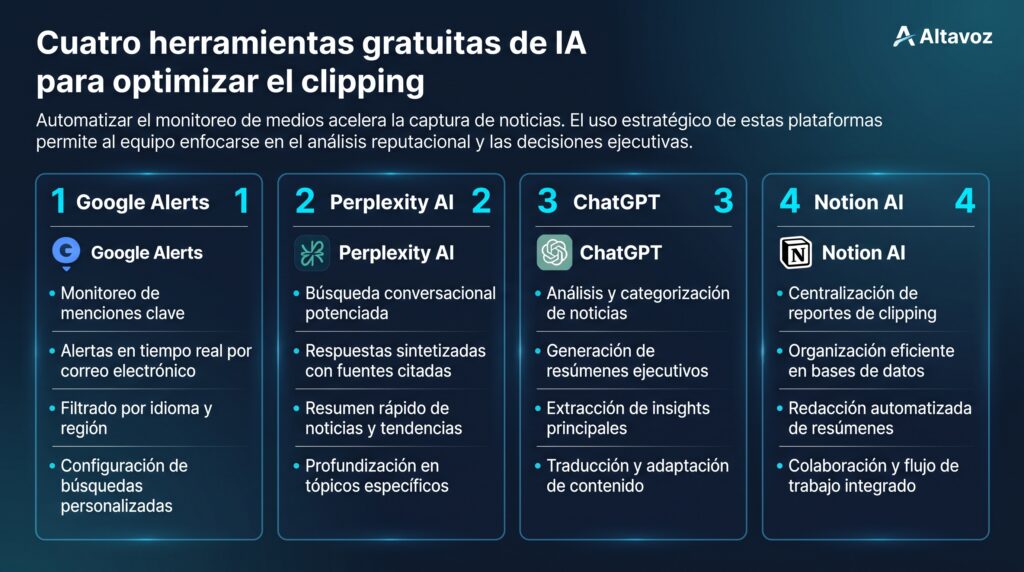
For teams looking to professionalize their press monitoring through efficient, accessible, high-operational-value solutions, four indispensable technology platforms stand out:
- Google Alerts with semantic processing: although it is a classic keyword-tracking tool, its integration with optimized search algorithms makes it possible to receive immediate notifications about brand, spokesperson or competitor appearances in media worldwide, serving as the first free capture line.
- Perplexity AI for coverage synthesis: used as a conversational search engine with real-time web access, it makes it possible to query a company’s media presence on a specific event, generate executive summaries of the news detected and cite the original publication links with journalistic precision.
- ChatGPT (OpenAI) for sentiment and impact analysis: by entering the texts or transcripts collected from press items, language models process the content to categorize the tone of the information (positive, neutral or negative), identify the key entities cited and extract the central ideas for the executive report.
- Notion AI for organizing and archiving clipping: makes it possible to structure dynamic databases of media appearances, automating tagging by media type, date, spokesperson and impact reach, making it easier to create executive dashboards accessible to the whole leadership team.
How to structure an automated, efficient clipping workflow
To consolidate a rigorous press monitoring process using accessible tools, communication areas must implement an orderly four-stage methodology:
- Configuring keywords and listening parameters: precisely define the brands, spokesperson names, products and competitors to be tracked in order to avoid informational noise.
- Automating capture and early alerts: integrate daily or immediate notification systems for critical mentions or atypical conversation spikes.
- Data processing and sentiment evaluation: use generative models to synthesize the articles detected and extract key tone and impact metrics.
- Consolidation into executive reports: present the relevant information structured in clean dashboards, highlighting links to the original items and the analytical value for management committees.
Strategic analysis as the true differentiator
Artificial intelligence tools facilitate the collection and synthesis of press clipping, but technology alone does not evaluate the real impact on reputation or manage relationships with journalists.
The senior communicator’s value lies in interpreting the data collected, contextualizing media coverage within the company’s objectives and turning press reports into strategic recommendations that protect the organization’s image.
At Altavoz Comunicaciones we advise companies and executives on designing and implementing comprehensive reputation, corporate communication and press management strategies. We support organizations in integrating technology tools into their communication processes to accurately measure their media presence, strengthen their brand positioning and build valuable relationships with the media.