
In today’s corporate and strategic communication environment, the border between organizational culture and external reputation has become completely permeable. For decades, corporate public relations operated under a one-way scheme in which messages about a company’s identity, values and labor policies were meticulously controlled from the press office. However, for general managers, HR managers, corporate affairs directors and executive committees, trying to project an attractive public image that doesn’t match employees’ internal reality represents one of today’s greatest reputational risks.
In an era where job review platforms, professional social networks and high talent turnover expose companies’ daily dynamics, internal culture and corporate reputation must be managed as a unified ecosystem. Employees are not simply recipients of internal communication; they are the first spokespeople, the validators of the value proposition and the most convincing asset for building trust among the public, investors and B2B customers.
Cultural incoherence as a trigger of brand crises
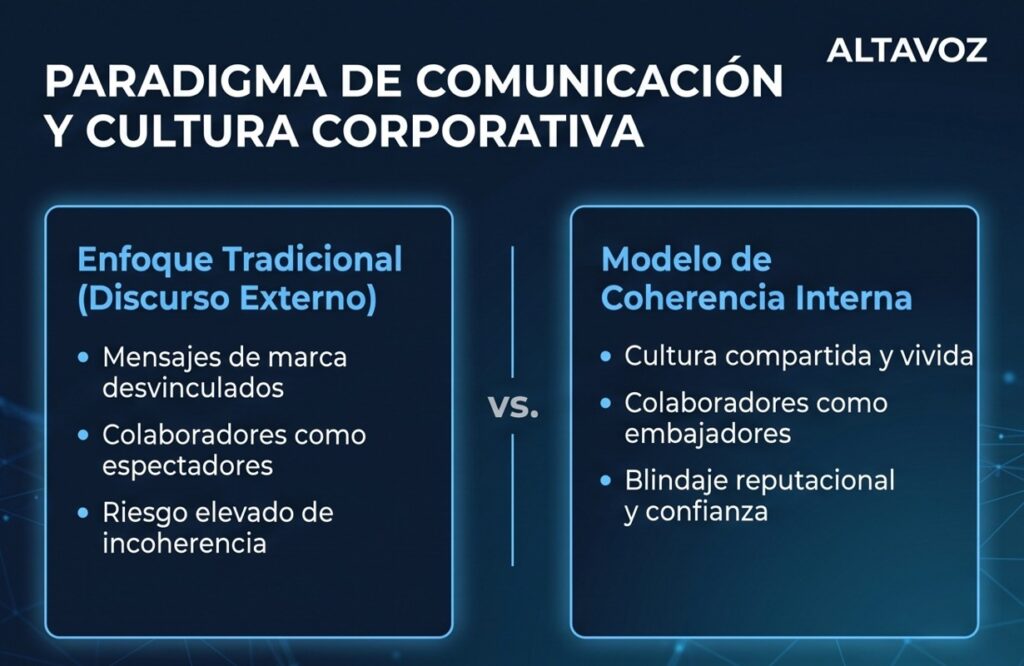
The most recurrent mistake in positioning strategies is treating employer branding and corporate communication as isolated disciplines. When an organization rolls out large-scale advertising campaigns on sustainability, diversity or empathetic leadership, but internally maintains high-friction work environments, a lack of transparency or rigid bureaucracy, the dissonance soon shows up in the public sphere.
Loss of credibility occurs when commercial promises collide with staff’s real experiences. A negative review on public job platforms or the leak of incoherent internal communications can invalidate years of investment in public relations. For senior management, understanding that reputation is not built from the outside in, but from the center of corporate culture, is the first step in shielding the company’s intangible asset.
Three pillars for turning work experience into public authority
For the strength of internal culture to carry over to the market organically and sustainably, corporate leadership must structure its strategy around three key axes:
1. Brand ambassador programs with strategic alignment
Encouraging professionals and area leaders to share their learnings, project achievements and industry views on their professional networks strengthens the company’s positioning. It is not about distributing standardized corporate scripts, but about training staff to communicate the organization’s values and technical rigor in their own voice.
2. Transparency in talent management and consistency in decision-making
An employer brand’s external reputation is not sustained by speeches, but by clear labor policies, pay equity, professional development programs and care for the team’s well-being. When commitments made to staff are met consistently, the market perceives the company as an ethical, solvent entity.
3. Integration between Internal Communication, Corporate Affairs and HR
Coordinated work among these three areas ensures that institutional milestones are communicated first to the internal team before being released to the media. An informed, engaged team understands the business’s strategic vision and responds in alignment during moments of transformation or reputational contingencies.
Executive action plan for turning culture into a reputational asset
Aligning the internal narrative with the company’s public perception requires the executive committee to implement a work plan organized into four stages:
- Audit of internal perception and employee experience: evaluate the work climate, the level of identification with the corporate purpose and the gaps between the brand’s discourse and daily operations.
- Spokesperson and personal brand training for executives and middle managers: train team leaders in transparent communication, thought leadership and ethical participation in public channels.
- Generating internal case studies with a journalistic approach: identify standout projects within the organization where employees’ talent solved a complex challenge, turning them into input for public relations and external communication.
- Integrated monitoring of employer brand and institutional reputation: jointly measure the level of internal satisfaction, the attraction of qualified talent and the company’s perception in the media and digital platforms.
The organization’s truth as the only possible shield
Corporate reputation is not a prefabricated narrative; it is the inevitable reflection of how human capital is managed day to day.
The companies that will lead their sectors will not be those that invest most in putting makeup on their image, but those that understand that a solid, ethical, people-oriented culture is the most powerful selling point and reputational shield in the business world.
At Altavoz Comunicaciones we advise executive committees, corporate affairs departments and HR management on designing and implementing comprehensive reputation, internal communication and institutional positioning strategies. We support organizations in structuring their corporate culture as an asset of public differentiation, ensuring a coherent voice that builds trust among employees, the media and the market.