A chief executive’s (CEO) schedule rarely has extensive windows for spokesperson training sessions before a media engagement. In situations of current events, business launches or opportunistic interviews with specialized media, corporate communication teams must execute an express preparation protocol. According to studies on executive communication published by Harvard Business Review, more than 80% of inaccuracies or failed messages in executive interviews are due to prior saturation of technical information and a lack of synthesis in the key messages before going on air.
In this context, preparing a CEO for an interview should not be understood as an exhaustive spokesperson workshop, but as an intensive 15-minute strategic alignment session designed to focus the corporate narrative, shield the company’s stance and ensure command of the conversation.
The danger of data saturation in executive spokesmanship
The most common mistake among public relations teams when advising a top executive with little time is to hand them lengthy memos with dozens of pages of hard data and background. Trying to memorize complex figures minutes before talking to a journalist creates anxiety, stiffness in expression and a high risk of losing the organization’s central idea.
A leader saturated with technical details tends to answer defensively or abstractly, drifting away from the business’s strategic objectives. The communication consultant’s job in an express format is to filter out the noise, prioritize the highest-impact data and deliver a clear mental outline that lets the spokesperson answer with fluency, authority and empathy.
This staged outline ensures the executive keeps editorial control during the interview, protecting institutional reputation and conveying the desired message to the target audience.
15-minute operational schedule for spokesperson preparation
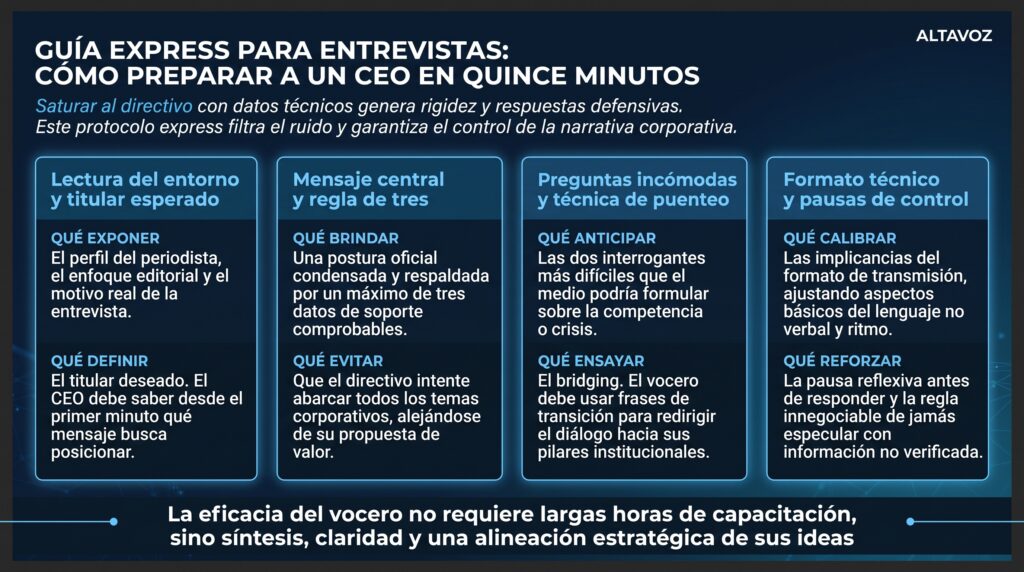
To make the most of every minute before the interview, the communication team must guide the training session under a rigorous structure divided into four work blocks:
1. Reading the environment and the interview’s objective
The journalist’s profile, the outlet’s editorial approach and the specific reason they sought the executive’s statement are summarized in three sentences. It is essential to define from the first minute what the desired headline is that the company seeks to position by the end of the dialogue.
2. Core message and the rule of three key ideas
The company’s official stance is set out condensed into a single main message and a maximum of three supporting ideas backed by verifiable data. The goal is for the executive not to try to cover all of the company’s topics, but to keep the conversation within the frame of their specialty and value proposition.
3. Anticipating complex questions and bridging technique (bridging)
The two most difficult or uncomfortable questions the journalist might ask about current events, competition or past crises are identified. Use of transition or bridging phrases (bridging) is rehearsed to gently redirect compromising questions toward the organization’s information pillars in a natural way.
4. Format adjustment, body language and final recommendation
A quick review of the technical aspects of the format (television, radio, print press or digital broadcast) is carried out, recalling basic recommendations on non-verbal language, tone of voice, speaking pace and the rule of not speculating on unverified data.
Methodology for keeping informational control during the interview
Ensuring the executive communicates effectively under pressure requires giving them practical narrative-control tools they can apply instinctively during the conversation:
- Inverted pyramid answer structure: always answer starting with the conclusion or the most important message, then briefly argue with context data.
- Strategic use of examples and concrete data: accompany corporate concepts with a practical case or a relevant figure that makes it easier for the journalist and the public to understand.
- Pace control and reflective pause: take a brief pause before answering complex questions to structure the idea and maintain a measured, confident tone.
- Closing by reaffirming the headline: use the final question or the farewell remarks to restate the organization’s key message.
Synthesis as a demonstration of leadership
Knowing how to prepare an executive in 15 minutes is a sign of methodological soundness and respect for senior management’s time.
A spokesperson’s effectiveness does not depend on the amount of time invested in prior preparation, but on the clarity, precision and strategic alignment of the ideas conveyed during the interview.
At Altavoz Comunicaciones we specialize in providing consulting in corporate communication, public relations and executive spokesperson training (media training for CEOs and management committees. We support organizations in structuring high-impact messages, training their leaders to interact with the media and protecting institutional reputation in any news scenario.