
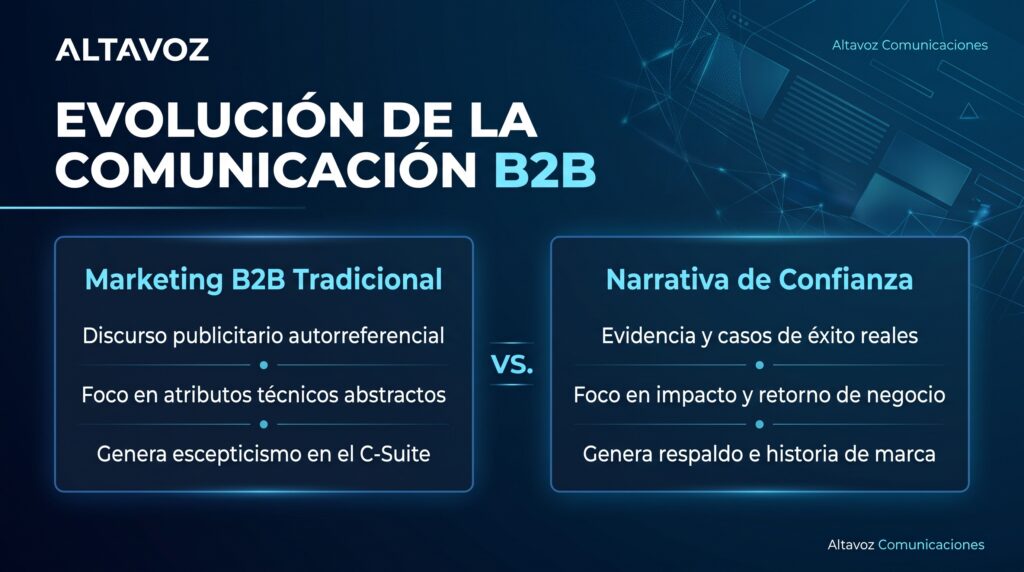
In the environment of corporate business and the acquisition of high-value technology services, the traditional B2B marketing model centered on mass advertising placement and self-referential sales pitches has lost effectiveness. Purchasing committees are made up of financial directors, technology managers and executive committees. These teams navigate complex, lengthy decision processes with a deep aversion to risk. Faced with large-scale contracts, standardized advertising promise doesn’t generate the conviction needed to close a negotiation.
In this market reconfiguration, B2B trust is built through real success stories and media validation. This narrative establishes itself as the most powerful strategic asset for reducing commercial friction, proving operational solvency and speeding up return on investment.
The exhaustion of commercial advertising with informed buyers
The most common mistake in managing B2B sales is to assume that increasing frequency or budget on digital ads (paid media) is enough to convince an executive committee. A contemporary corporate buyer is not looking for ads; they look for proven evidence of how a solution solved a similar challenge in a company of the same sector or complexity.
When a company bases its positioning only on advertising messages, the prospect perceives an evident commercial bias. In contrast, when that same company’s operational achievement, efficiency gained or cost reduction is documented through a rigorous case study and disseminated by independent media (earned media), the message becomes incontestable social proof.
Three reasons real success stories drive sales closing
Structuring the corporate communication strategy around real customer stories brings tangible advantages in enabling B2B sales:
1. Disarming risk objections in C-Suite committees
The main brake on a high-value B2B sale is not the solution’s cost, but the customer’s fear of a failed implementation. A detailed success story that explains the methodology applied, the obstacles overcome and the results obtained acts as a guarantee of solvency that reassures decision-makers.
2. High-value content for press coverage (Earned Media)
Journalists at financial media and business portals systematically discard press releases with an advertising tone. However, a real success story that illustrates a sector trend or a digital transformation process is valuable journalistic input that attracts high-impact editorial coverage.
3. Clear differentiation from the silent competition
In tenders or selection processes where technical proposals are similar, the balance usually tips toward the organization that demonstrates a transparent track record backed by testimonials from satisfied customers.
Strategic matrix: paid advertising versus trust narrative
Evaluating the impact of both approaches at the different stages of the sales cycle helps explain why real evidence beats traditional advertising:
| Evaluation criterion | Traditional paid advertising | Trust narrative with real cases |
|---|---|---|
| Level of credibility | Low; perceived with direct commercial bias | High; backed by customer experience |
| Target audience | Broad but poorly qualified reach | Purchasing committees, executives and key media |
| Role in the B2B funnel | Initial visibility generation | Risk reduction, enablement and closing |
| Asset durability | Ephemeral; ends when ads are paused | Durable; strengthens the brand’s reputation library |
| Effect on negotiation | Minimal; doesn’t resolve complex objections | Decisive; speeds up contract signing |
The customer’s truth as the best sales argument
In the B2B market, brands are not consolidated by what they claim about themselves in advertising campaigns, but by the real value they generate in their customers’ operations.
The companies that will lead their industries will be those that know how to turn their users’ achievements into high-authority journalistic stories, building a transparent reputation that inspires trust and guarantees business growth.
At Altavoz Comunicaciones we specialize in providing consulting in corporate communication, public relations and B2B positioning for technology companies, complex services and executive committees. We support organizations in structuring their success stories with journalistic rigor, building the trust narrative needed to back their sales teams and secure a high-impact media presence.