In the dynamism of public relations and corporate communication, the moment before pressing the send button on a press release is the last quality-control barrier. Media newsrooms receive hundreds of news items a day, so a technical failure, an unverified fact or an unappealing subject line eliminates any chance of press coverage. According to media relations management data published by the Public Relations Institute, more than 60% of releases immediately discarded by editors have basic formatting errors, inaccurate contact details or a lack of journalistic angle in the subject line.
In this landscape, the checklist before sending a press release becomes an indispensable risk-control protocol, ensuring the company’s message reaches journalists with maximum editorial rigor, professionalism and newsworthiness.
The danger of operational haste in press distribution
The most recurrent mistake among public relations teams is rushing to send the release once final internal approval has been obtained. The rush to meet a schedule or gain immediacy usually leads to costly omissions: broken links, inaccurate figures, typos in spokespeople’s titles or mass emails with visible recipients.
Sending an item with inaccuracies not only destroys the chance of publication of the current topic; it erodes the credibility of the agency and the company with journalists. An editor who receives poorly structured material or material with wrong data quickly classifies the sender as an unreliable source, compromising future press efforts.
A short five-minute protocol makes it possible to identify and correct operational failures before the message reaches newsrooms, ensuring that the press release’s first impression is impeccable.
Five points to consider in the checklist before sending a press release
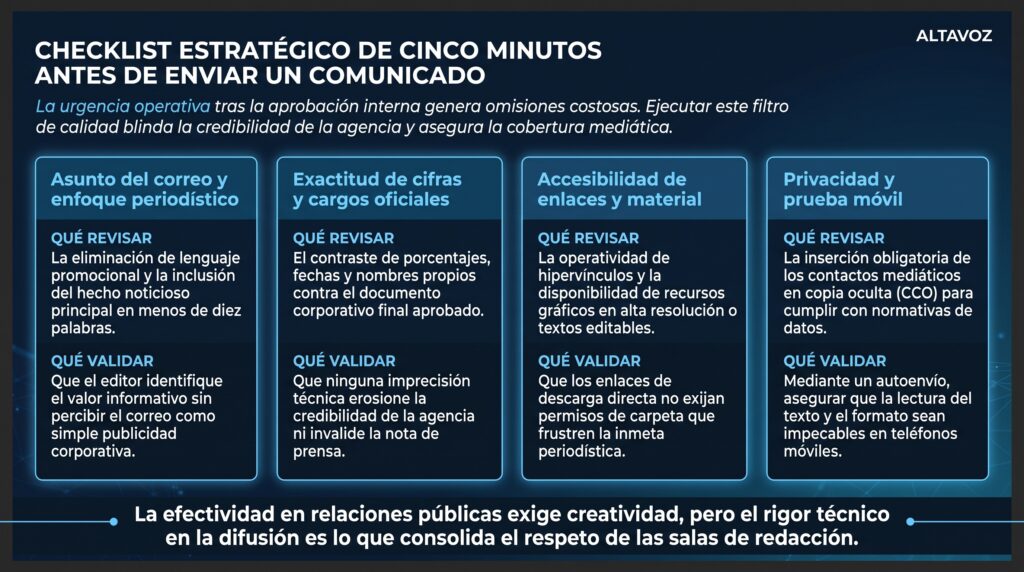
To ensure efficient distribution and protect institutional reputation, the communication team must carry out these five systematic checks before issuing the information:
1. Email subject that is clear, attractive and free of advertising language
The subject (subject line) determines whether the journalist will open the email or send it to the trash. It must summarize the news in fewer than ten words, including the main fact and the relevant entity, avoiding grandiloquent terms or promotional statements.
2. Verification of figures, dates and official titles
It is essential to do a cross-check reading to confirm that numbers, percentages, event dates and proper names match exactly the information approved by the company. An error in a financial figure or in a spokesperson’s title invalidates the item.
3. Checking links, attachments and visual material
Verify that high-resolution images, graphics or editable-format notes are correctly attached or available through a direct download link with no access restrictions. Editors have no time to request folder permissions.
4. Direct contact details for spokespeople and boilerplate
The release must include the company’s institutional profile (boilerplate) and the direct details of the person responsible for press (mobile phone and email). If a journalist decides to cover the news and needs to arrange an interview immediately, they must be able to reach the contact without intermediaries.
5. Privacy settings and sending a test email
Before running the mass send, it is mandatory to send a test message (test) to your own account to check the format on mobile devices and computers. Also, verify that the journalist list is placed in the blind copy (BCC) field to comply with data protection regulations.
Methodology for institutionalizing quality control in public relations
Consolidating a standard of excellence in news distribution requires incorporating this checklist into the communication team’s daily routine through four work actions:
- Standardized digital checklist template: make available to the team a mandatory-use checklist before scheduling or sending any press release.
- Cross-review by a second set of eyes (peer review): establish that the final version of the email be reviewed by a professional other than the one who wrote the text in order to identify undetected errors.
- Media database audit: keep journalists’ contacts updated and segmented by specialty to avoid irrelevant sends that lead to email blocks.
- Post-send evaluation: analyze open rates, editor responses and coverage obtained to identify opportunities for improvement in future sends.
Methodological rigor as a guarantee of credibility
The effectiveness of public relations management is measured not only by the creativity of the approach, but by precision and professionalism in technical execution.
Organizations that apply rigorous quality control to their communications build relationships of trust with the media, ensuring their institutional voice is respected and valued by editors and journalists.
At Altavoz Comunicaciones we specialize in providing consulting in corporate communication, public relations and press management for companies and executive committees. We support organizations in structuring their distribution strategies with journalistic rigor, turning institutional information into valuable stories that strengthen reputation and generate real impact on the business.