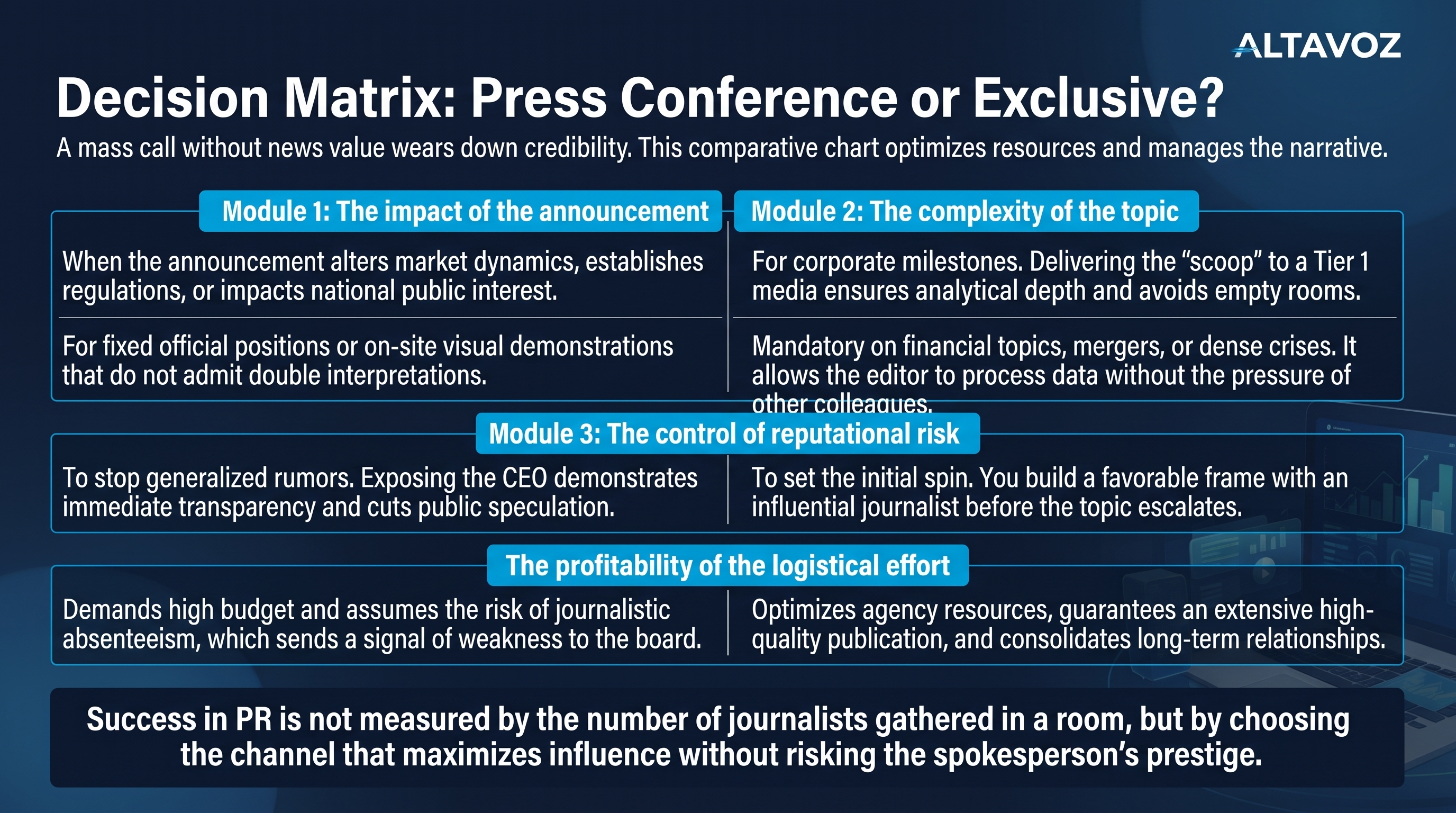
In public relations and corporate communications management, selecting the appropriate format and channel to disseminate a corporate milestone directly dictates reputation levels, journalistic interest, and business impact. Frequently, executive boards and brands make the mistake of assuming that any internal announcement warrants calling a mass media gathering. However, overexposure and improper use of press conferences strain journalist relationships and expose the company to low attendance when the announced fact lacks genuine news value.
In this environment, utilizing a press conference decision matrix enables communications leaders to evaluate with journalistic rigor when to convene a mass in-person meeting versus when to opt for an exclusive interview strategy (one-on-one), safeguarding spokesperson authority and optimizing corporate resources.
The danger of over-convening and lacking a journalistic angle
The most common error among PR teams is confusing the internal corporate value of an announcement with its actual journalistic news value. Organizing a press conference for minor product updates, routine rebrandings, or operational announcements creates frustration among editors and reporters who invest coverage time in events that could have been handled via a press release.
When media outlets attend a mass press conference only to find a lack of substance, fresh data, or public interest, the agency's and company's credibility is damaged. For executive appearances, exposing a Chief Executive Officer (CEO) to a half-empty room or irrelevant questioning conveys institutional weakness and market disinterest.
Applying a pre-assessment filter allows PR advisors to guide clients toward the format that maximizes coverage across key outlets, building long-term trust relationships with newsrooms.
We build reputation

Decision matrix for evaluating public spokesperson strategy
To objectively determine whether a corporate announcement should be channeled through a mass press conference or an exclusive interview framework, communications teams should subject the news event to the following strategic variables:
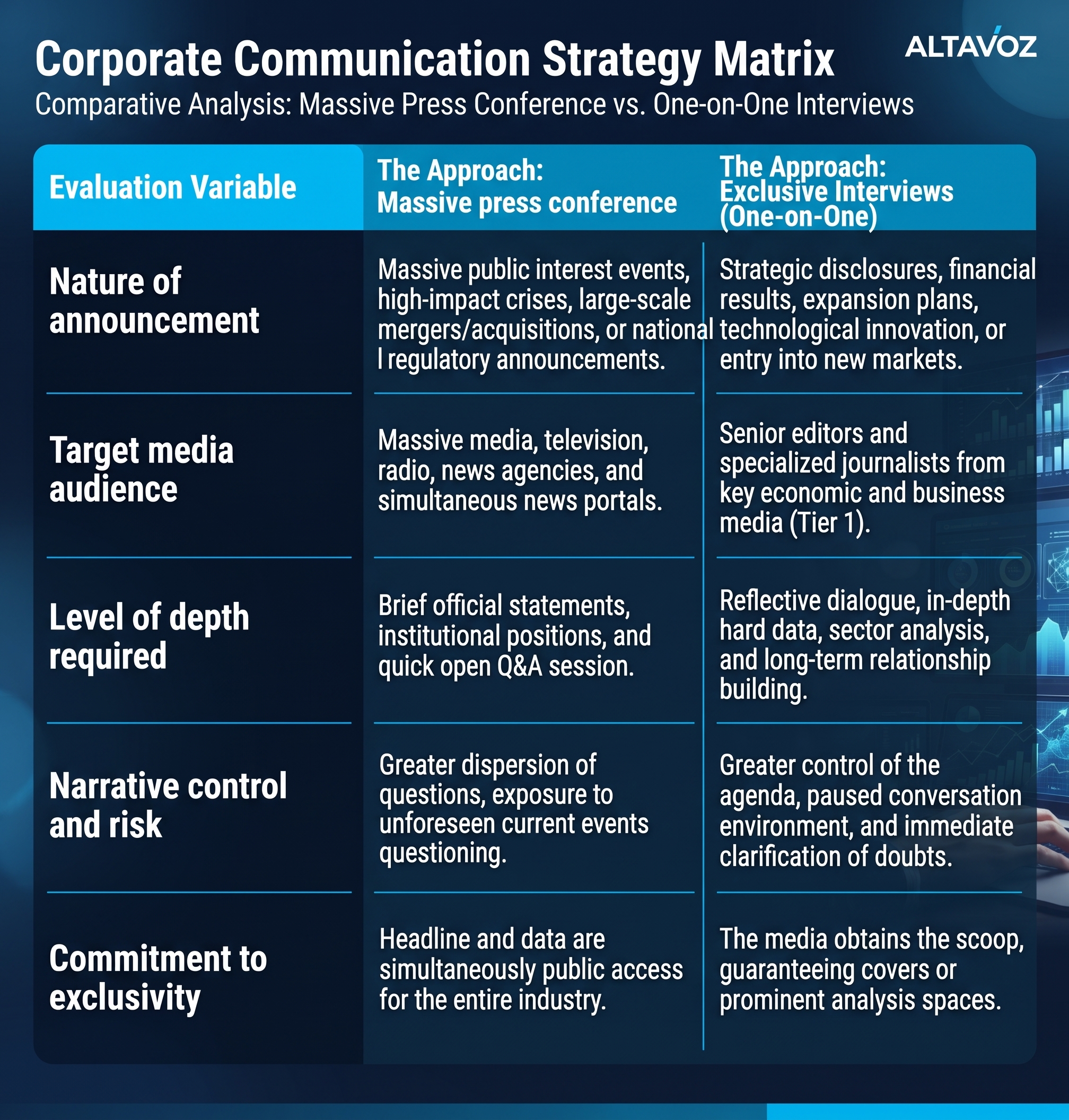
Execution process based on chosen format
Once the channel is established via the decision matrix, communications leadership must coordinate plan execution using tailored methodologies for each format:
Approach for mass press conferences
- News value verification: ensuring the announcement includes fresh hard data, direct social or business impact, and available top-tier spokespersons.
- Timely invitations & follow-up: issuing press invites with adequate lead time (48 to 72 hours prior), confirming attendance with desk editors and reporters.
- Digital press kit production: immediately providing press releases, fact sheets, executive bios, and high-resolution media assets to facilitate journalist coverage.
Approach for exclusive interviews
- Targeting Tier 1 media outlets: identifying the outlet and journalist whose editorial focus delivers maximum strategic value to company positioning.
- Scoop negotiation & embargos: agreeing on publication timing and conditions with the selected journalist before releasing general information.
- Deep-dive briefing document prep: equipping executives with industry background data, verified financial figures, and context analysis to enrich the dialogue.
Respecting the media agenda as a reputational asset
Deciding how to present news to media outlets is a clear marker of institutional maturity and respect for journalistic work.
Organizations that understand when to gather a critical mass of journalists versus when to offer exclusives to specialized outlets secure higher quality coverage while building their positioning as trusted information sources across the business landscape.
At Altavoz Comunicaciones, we specialize in corporate communications counsel, public relations strategy, and media relations for business leaders and executive boards. We help organizations structure their spokesperson and media distribution strategies with journalistic rigor, choosing the most efficient formats to protect brand equity and drive business results.