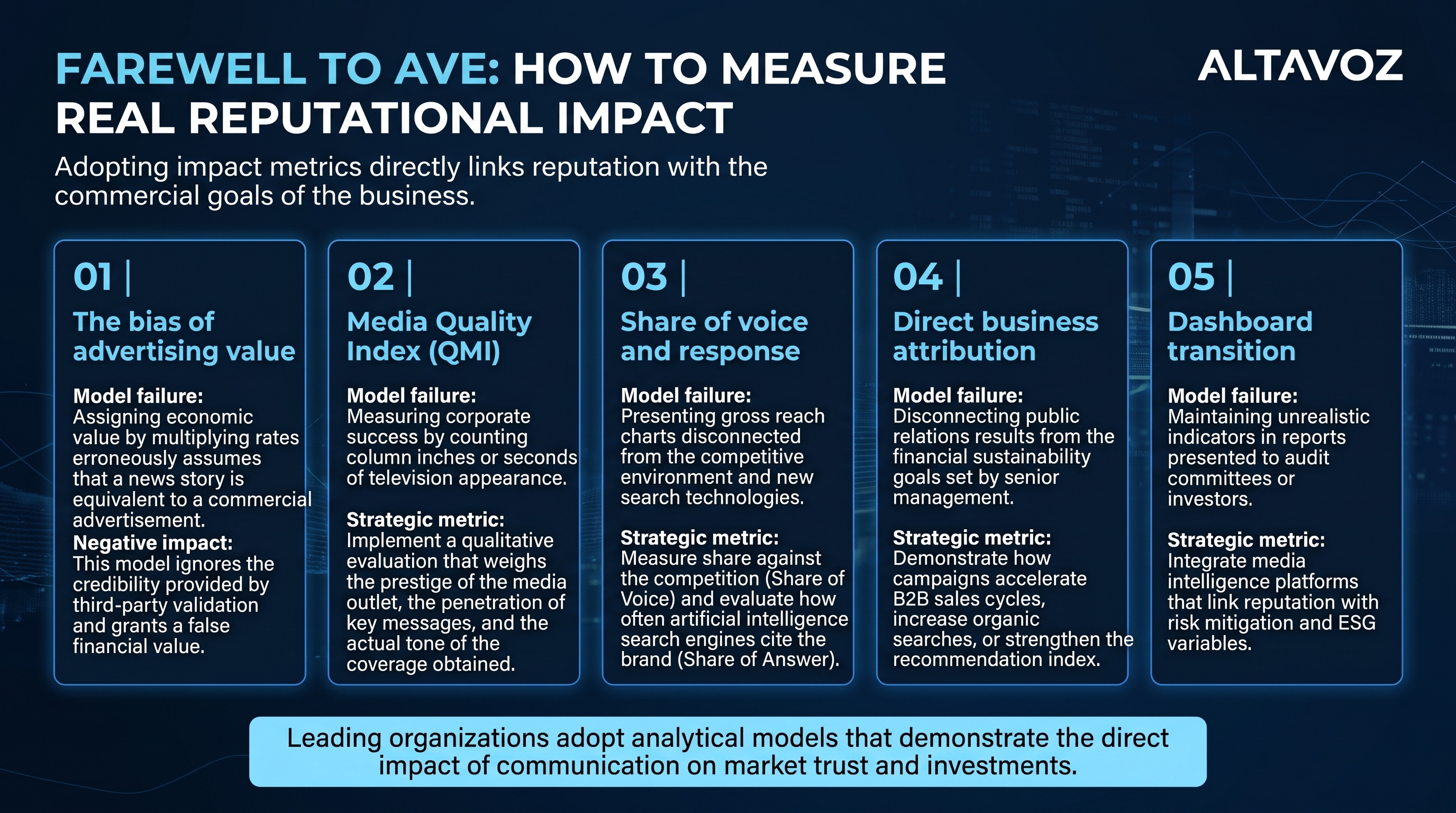
For decades, public relations and corporate communications performance was dominated by Advertising Value Equivalency (AVE). This metric attempts to assign a monetary value to earned media coverage by calculating what that same editorial space would cost as paid advertising. AVE has been universally rejected by leading global communications associations and executive boards. Equating a news article or executive interview to a paid banner ad ignores the fundamental mechanisms of editorial credibility, brand trust, and independent third-party validation (earned media).
For chief executive officers, audit committees, chief financial officers, and corporate affairs leads, continuing to evaluate reputational performance using AVE introduces severe distortions into executive reporting. Justifying communications investments to executive leadership requires adopting PR impact metrics and ROI frameworks aligned with the Barcelona Principles, AMEC frameworks, and tangible business goals.
The methodological flaw of Advertising Value Equivalency (AVE)
The primary reason global PR measurement bodies reject AVE is its complete failure to measure audience perception changes or business outcomes. A paid ad delivers a controlled message; editorial media coverage provides third-party validation, context, and market authority.
Relying on AVE introduces three critical distortions into executive decision-making:
- Fictitious financial attribution: multiplies ad rate costs by arbitrary multipliers (3x or 5x) under the false premise that press coverage equals paid advertising.
- Disregard for tone and key messaging: assigns the exact same "monetary value" to a negative or inaccurate article as it does to a glowing feature that articulates core corporate differentiators.
- Disconnection from business outcomes: fails to measure whether media coverage drove purchase consideration, talent acquisition, risk mitigation, or investor confidence.
Methodological alternatives to measure true reputational impact
Replacing vanity metrics with impact indicators requires implementing frameworks that evaluate message effectiveness across the entire corporate reputation funnel:
1. Quality Media Index (QMI)
This methodology evaluates media coverage through a combined quantitative and qualitative scoring system. It assigns weights across critical variables: publication prestige, key message penetration, direct executive spokesperson quotes, coverage tone (positive, neutral, or negative), and headline prominence relative to industry competitors.
2. Share of Voice and Share of Answer
Measures an organization's percentage of media coverage relative to direct competitors across traditional publications (Share of Voice), as well as how frequently and accurately generative AI conversational search engines cite the brand when answering industry queries (Share of Answer).
3. Business attribution and stakeholder trust impact
Evaluates correlations between communications campaigns and core business drivers: organic brand search increases, shortened B2B sales cycles through third-party validation, improved Net Promoter Scores (NPS), and qualified talent acquisition.

Strategic matrix: from AVE to true impact metrics
Transitioning from ad-centric thinking to reputational analytics requires restructuring executive KPI reporting:
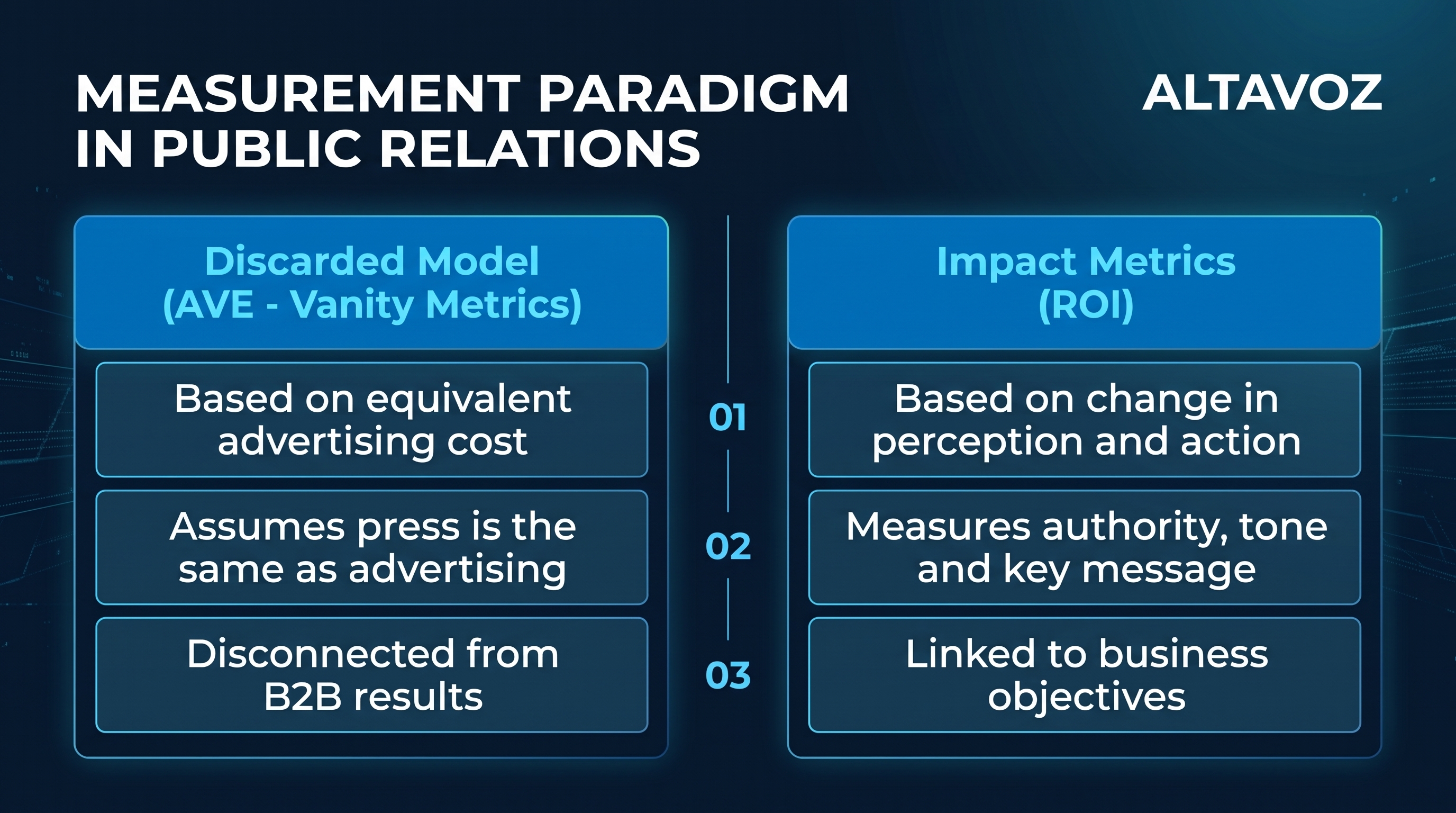
| Evaluation dimension | Obsolete vanity metric (AVE) | Strategic impact alternative |
|---|---|---|
| Financial valuation | Ad rate cost multiplied by arbitrary factors | Return on Investment (ROI) correlated with sales enablement or crisis cost savings |
| Message analysis | Column inches, square centimeters, or broadcast seconds | Key message penetration percentage and brand prominence scoring |
| Tone & sentiment | No distinction; negative coverage counts as "value" | Sentiment scoring, favorability analysis, and qualitative tone audits |
| AI & digital presence | Zero adaptation to modern search environments | Share of Answer in conversational AI engines and Generative Engine Optimization |
| Board alignment | Viewed as cosmetic PR claims lacking financial rigor | Integrated into corporate ESG, risk management, and governance dashboards |
Executive roadmap for analytical transition
Adopting a rigorous reputation measurement methodology requires executive leadership to oversee a structured, four-phase implementation:
- Defining core reputational KPIs: establishing quantifiable targets tied directly to the annual corporate strategy (spokesperson positioning, key message penetration, share of voice).
- Auditing and eliminating AVE reporting: discontinuing equivalent ad values across all performance reports submitted to board members or investors.
- Deploying media intelligence and social analytics tools: adopting analytical platforms that process media coverage, digital sentiment, and synthetic search data using qualitative criteria.
- Integrating PR reporting with commercial and finance teams: measuring how earned media coverage supports brand equity, B2B lead acceleration, and crisis risk mitigation.
Analytical rigor as the foundation of brand equity
Corporate reputation is a high-value intangible asset that must be measured with the same financial discipline and analytical rigor as any other operational function.
The market leaders of tomorrow will not be those relying on cosmetic PR metrics from the past, but those deploying modern measurement frameworks that prove how strategic communications builds market trust, drives investor confidence, and safeguards enterprise value.
At Altavoz Comunicaciones, we advise executive committees, corporate affairs directors, and communications leads on designing comprehensive reputation measurement frameworks and media impact evaluations. We help organizations build analytical dashboards that articulate true PR ROI, delivering high-value reporting to executive boards and investors.