
It is not about choosing a platform, but about integrating them. Discover how to use Meta to generate demand and Google to capture it, maximizing the return on your B2B investment.
In corporate marketing financial planning and B2B sales, capital allocation to digital advertising (paid media) often becomes a recurring debate within management committees. Choosing between Meta and Google is not a dilemma about which platform is superior in absolute terms, but a strategic decision about how to intercept buyer intent at the different stages of their evaluation cycle. When an organization handles highly complex services, enterprise software or B2B consulting, distributing budget without understanding each ecosystem’s role drives up cost per acquisition and dilutes return on investment (ROI).
For marketing directors, sales managers and executive committees, optimizing the B2B budget on Meta and Google requires integrating paid advertising into a balanced acquisition model, backed by the brand authority provided by third-party validation (earned media).
Understanding the dynamics of each ecosystem in the B2B funnel
The most common mistake in managing paid campaigns is to measure Meta and Google under the same performance parameters. Each platform operates under a different psychological and technical principle with respect to the user:
- Google Search and capturing explicit demand: when a decision-maker or evaluation committee actively searches for a B2B solution, a software category or a specialized supplier, they show mature purchase intent. Google acts in the final stretch of the funnel, capturing prospects who already recognize an immediate need.
- Meta and latent demand generation (Demand Generation): executives don’t go on social media intending to buy technology infrastructure or corporate services. However, targeting models based on professional profile and behavior make it possible to show case studies, market research and innovative solutions to specific audiences, sparking interest before the formal search begins.
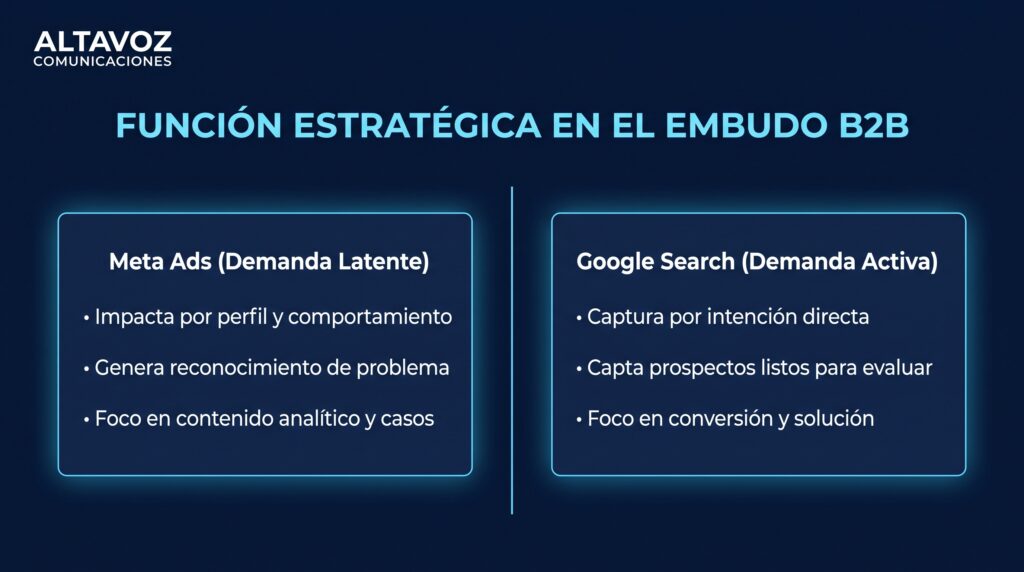
Combining awareness generation on Meta with high-intent capture on Google makes it possible to cover the entire decision cycle without wasting capital on unqualified clicks.
Three executive criteria for distributing advertising investment
To define the distribution of the commercial budget, senior management must evaluate three key factors tied to the maturity of its market and the type of solution:
1. Level of category awareness in the market
If the B2B solution belongs to an established category where customers actively look for competitors or alternatives, Google Search should receive most of the budget. If the proposition is innovative or creates a new category, Meta is indispensable for educating the market and generating initial demand.
2. Length and complexity of the B2B sales cycle
In high-value contracts involving C-Suite committees, a direct sales ad on Google will hardly close the transaction. Meta makes it possible to maintain a constant presence (retargeting) feeding the buyer with real success stories, technical reports and authority content throughout months of evaluation.
3. The catalyzing role of earned media and brand reputation
On both Meta and Google, cost per click and conversion rate depend directly on the level of trust in the brand. When a company has active coverage in economic and business media, prospects respond more effectively to paid advertising, recognizing the organization as a solvent, validated player in its industry.
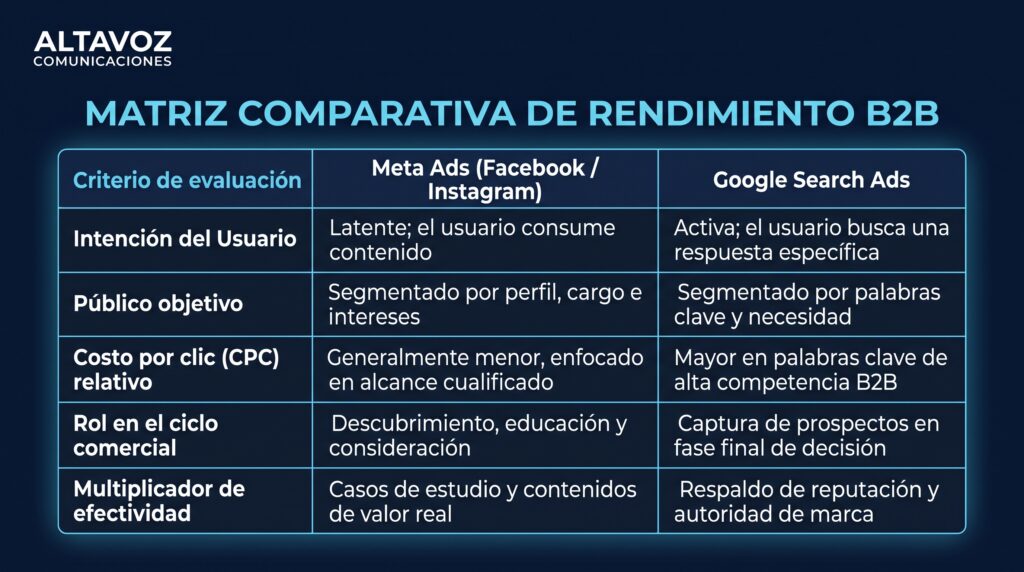
Comparative matrix: attribution and performance by channel
Evaluating each platform’s contribution within the B2B investment model makes decision-making easier for the marketing committee:
Advertising as an amplifier of corporate trust
Allocating B2B advertising budget is not about picking a winner between Meta and Google, but about orchestrating both channels under a solid reputation strategy.
The organizations that achieve the highest return on investment will be those that understand that ads don’t create trust on their own; they amplify it when it is backed by the truth of the brand, demonstrable experience and validation in the media.
At Altavoz Comunicaciones we advise technology companies, complex services and executive committees on designing and implementing comprehensive reputation, corporate communication and B2B positioning strategies. We support organizations in structuring their narratives and success stories with journalistic rigor, generating the brand authority needed to boost the effectiveness of their commercial investments and speed up business growth.