
In commercial strategy, B2B marketing, and corporate public relations, executive decision-making has shifted from purely intuitive approaches toward predictive data analytics. The accelerated advancement of artificial intelligence and big data processing enables organizations to project market trends, consumer habits, and audience responses with unprecedented technical precision. However, for executive boards, corporate affairs leads, and brand managers, a core question remains: to what extent can algorithmic models anticipate human behavior when it is driven by emotions, cultural biases, and unexpected contextual shifts?
In this environment, understanding the interaction between AI predictive analytics and human emotion becomes a vital requirement for designing communication strategies that maximize analytical efficiency without losing social awareness or empathy.
The illusion of perfect predictability in analytical models
The most frequent error across planning and market intelligence departments is assuming that human behavior follows a linear logic fully measurable through algorithms. Artificial intelligence processes historical records, digital interactions, and browsing habits to spot correlations. Nevertheless, high-ticket purchasing decisions and public perception shifts are heavily dictated by emotional triggers, environmental dynamics, and sudden crises.
When an organization relies blindly on predictive models without human editorial oversight, it risks launching messaging detached from actual audience sentiment. The technology's inability to experience genuine emotions means its projections lack the flexibility required during unscripted market events.
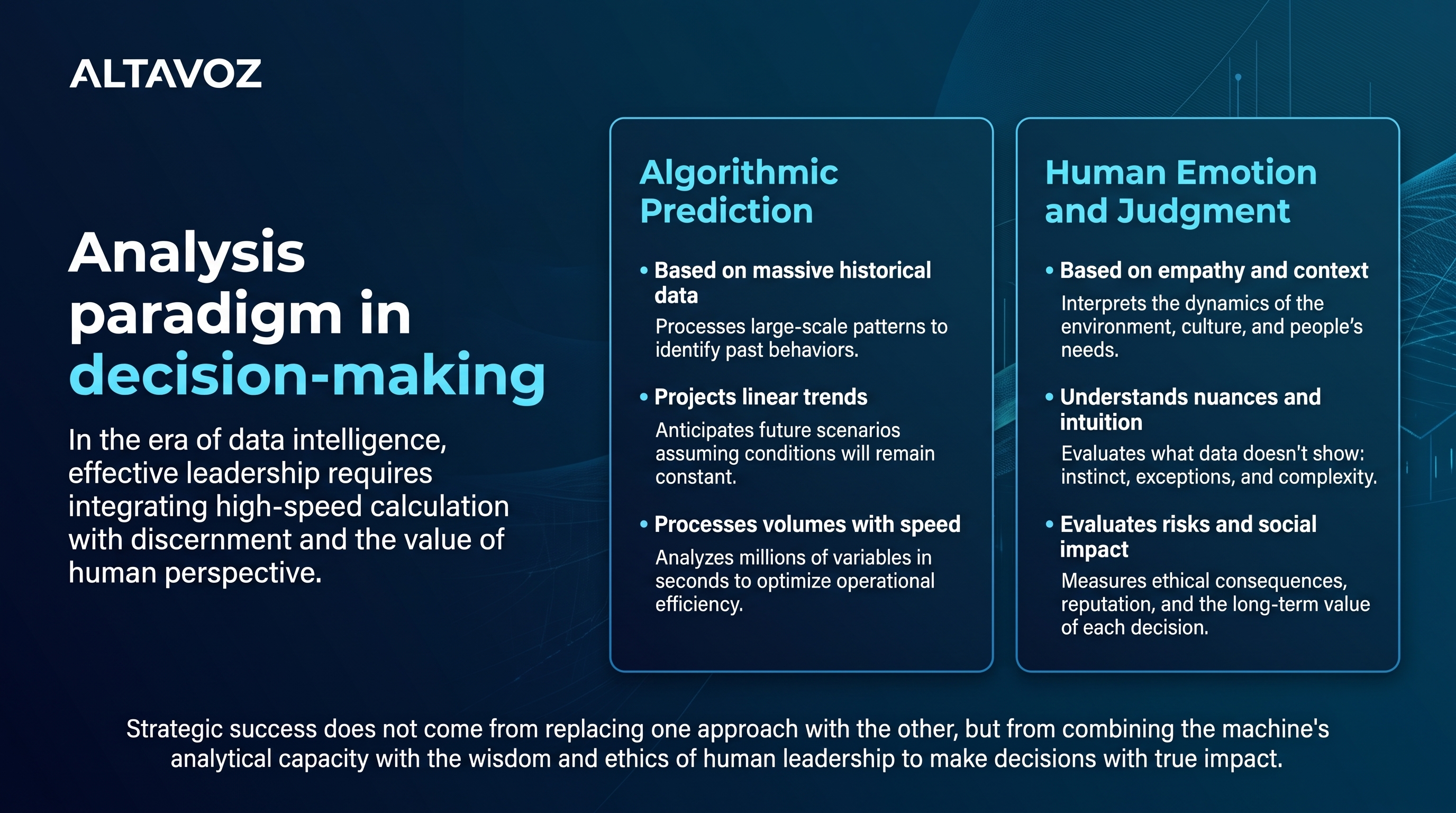
Combining the quantitative power of analytical models with human professional judgment establishes a balanced governance framework that strengthens executive decision-making.
Three structural limits of artificial intelligence regarding human psychology
To leverage predictive models without compromising corporate reputation or campaign effectiveness, executive leadership must keep three core limitations in mind:
1. Reading social context and cultural nuance
Natural language processing models identify grammatical structures and semantic patterns, but stumble when interpreting sarcasm, humor, or subtle shifts in public sentiment. Navigating these variables requires critical analysis from communications specialists who understand local realities.
2. Sudden behavioral shifts driven by emotional events
During operational disruptions, market shocks, or social crises, audiences react under immediate emotional dynamics that disrupt historical patterns. In these scenarios, predictive models offer outdated estimates, whereas human leadership can pivot positioning in real time.
3. Ethical dimension and value judgment
Artificial intelligence estimates probabilities, but cannot make ethical judgments regarding the reputational suitability of a message. Deciding how to navigate sensitive issues or position a firm during industry debates demands a human framework built on corporate values and social responsibility.
Comparative matrix: AI predictive capabilities versus human intervention
Evaluating the contribution of each approach within corporate communications strategies helps structure a collaborative workflow:
| Evaluation dimension | AI predictive analytics | Human emotion & judgment |
|---|---|---|
| Data volume processing | High; identifies patterns across massive datasets | Limited in speed when processing raw datasets |
| Understanding nuance & emotion | Synthetic; categorizes variables quantitatively | Deep; interprets sensitivities, values, and empathy |
| Adaptability to unexpected events | Rigid; depends on historical training data quality | Flexible; adjusts messaging intuitively |
| Reputational risk assessment | Grounded in historical probabilities | Grounded in strategic vision and social impact |
| Building public trust | Zero; perceived as cold calculation | High; authentic human touch builds lasting trust |

Balancing analytical precision with empathy
Artificial intelligence does not replace human intuition or executive leadership, but it enhances strategic capabilities when used as an analytical co-pilot.
The market-leading organizations of tomorrow will not be those that delegate decisions blindly to algorithms, nor those that ignore data, but those that combine technological precision with the empathy, rigor, and ethics of communications professionals.
At Altavoz Comunicaciones, we specialize in corporate communications counsel, public relations strategy, and brand positioning for business leaders and executive boards. We help organizations integrate advanced data tools into their communication workflows, ensuring strategic narratives that engage key media outlets and protect enterprise value.