



It’s not about choosing one platform, but integrating them. Discover how to use Meta to generate demand and Google to capture it, maximizing your B2B return on investment.
When structuring corporate marketing budgets and high-ticket B2B sales strategies, allocating digital ad spend (paid media) routinely triggers debate within executive committees. Choosing between Meta and Google is not a question of which platform is universally superior, but rather a strategic decision on how to intercept buyer intent across different stages of their decision journey. When an organization manages complex enterprise software, tech infrastructure, or strategic consulting services, misallocating capital across channels inflates acquisition costs and dilutes return on investment (ROI).
For marketing leads, commercial directors, and executive boards, optimizing B2B ad spend allocation across Meta and Google requires integrating paid channels into a balanced acquisition model backed by third-party brand validation (earned media).
Understanding platform dynamics within the B2B sales funnel
The most common error in paid media management is evaluating Meta and Google using identical performance metrics. Each platform operates under distinct psychological and technical mechanics:
- Google Search and explicit demand capture: when a decision-maker or buying committee actively searches for B2B solutions, tech categories, or specialized providers, they demonstrate mature purchase intent. Google operates at the bottom of the funnel, capturing leads with an immediate, defined need.
- Meta and latent demand generation (Demand Generation): executives do not browse social media platforms to purchase enterprise infrastructure. However, advanced demographic and behavioral targeting allow companies to put real case studies, market research, and innovative solutions in front of specific professional profiles, stirring demand before active search begins.
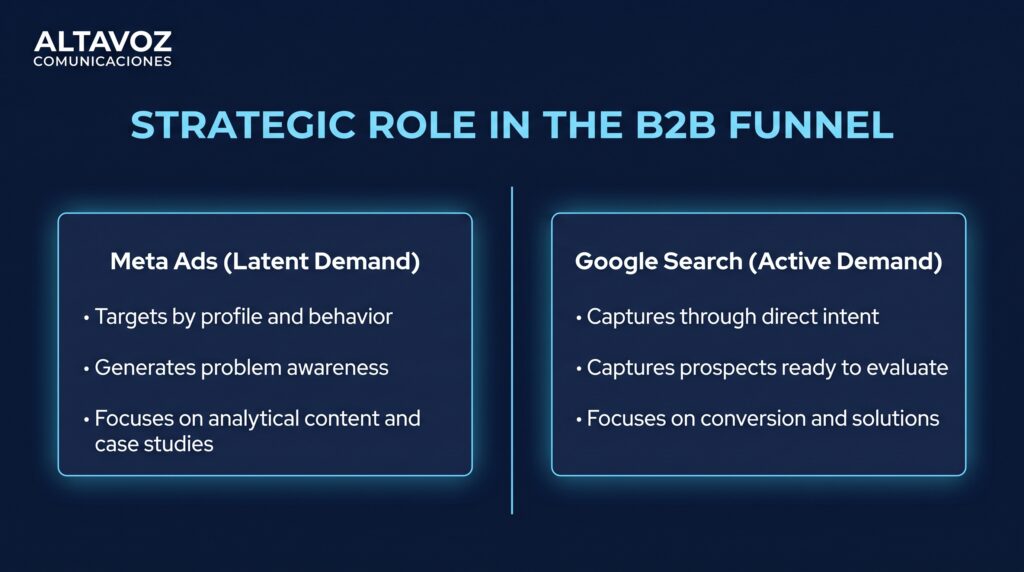
Combining upper-funnel demand generation on Meta with high-intent search capture on Google enables organizations to cover the entire decision cycle without wasting capital on unqualified clicks.
Three executive criteria for allocating digital ad spend
To establish an optimal budget distribution, C-suite leadership must evaluate three core business variables:
1. Market awareness of the product category
If a B2B solution belongs to an established category where prospects actively search for competitors or alternatives, Google Search should receive the primary share of investment. If the solution introduces a novel category or approach, Meta is essential to educate buyers and stimulate initial demand.
2. Length and complexity of the B2B sales cycle
For high-ticket enterprise contracts involving multi-stakeholder buying committees, a direct search ad rarely executes a deal on first touch. Meta enables long-term retargeting, nurturing decision-makers with case studies, technical whitepapers, and authoritative content across extended evaluation cycles.
3. The catalytic role of earned media and brand equity
Across both Meta and Google, conversion rates and cost-per-click metrics depend heavily on brand trust. When a firm maintains consistent coverage across top-tier business outlets, prospects engage more readily with paid campaigns, recognizing the brand as a market-validated vendor.
Strategic matrix: channel attribution and performance metrics
Evaluating platform contributions across the B2B sales funnel equips marketing committees to make data-informed budget decisions:
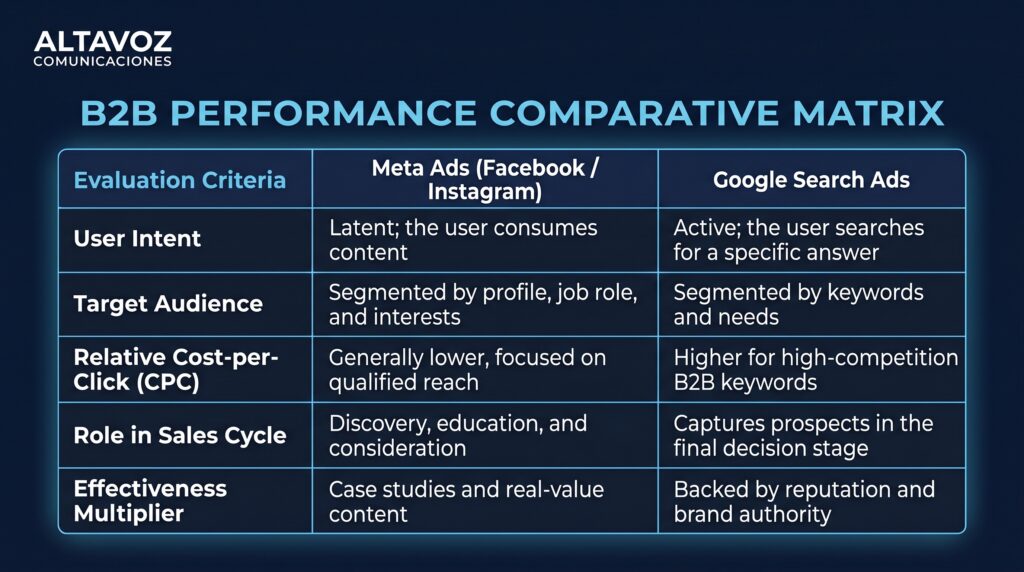
Ad spend as an amplifier of corporate trust
Allocating B2B ad spend is not about picking a winner between Meta and Google, but orchestrating both channels under a unified brand reputation strategy.
The organizations achieving highest return on investment will be those realizing that ads do not create trust in isolation—they amplify it when backed by corporate truth, proven experience, and news media validation.
At Altavoz Comunicaciones, we advise technology providers, complex service firms, and leadership teams on designing comprehensive reputation management, corporate communications, and B2B positioning strategies. We help organizations structure narrative assets and case studies with journalistic rigor, building the brand authority needed to maximize paid media efficiency and drive sustainable enterprise growth.